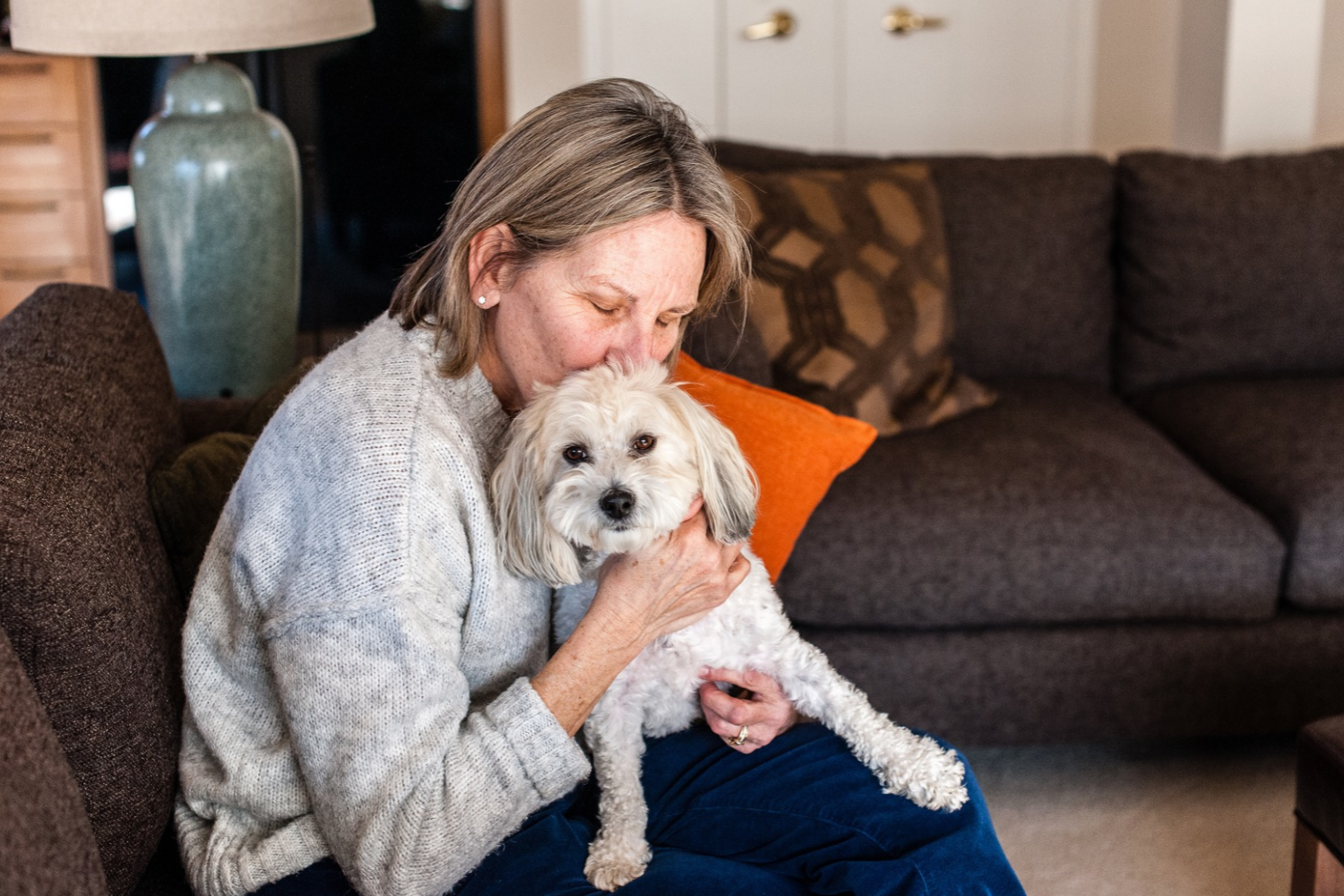
The bond between people and animals is powerful. For many families, that bond is a source of comfort, connection, and safety. But when violence enters the picture, that same bond can be exploited to cause harm and exert control. Earlier this year, DFTP hosted Emily Lewis and Kathleen Wood of the Animal Legal Defense Fund (ALDF) for a special presentation titled “Protecting All Victims: How the Law Addresses Animal Abuse, Family Safety, and Professional Reporting.” Emily and Kathleen, the managing attorney and senior staff attorney, respectively, for the ALDF Criminal Justice Program, brought a wealth of experience and expertise on “the Link” between animal abuse and interpersonal violence. Their presentation addressed the dark side of the human-animal bond with case studies, theories on the origins of the Link, and a review of the existing laws that use the Link to protect people and animals.
We’re sharing the highlights from their presentation to help you better understand the Link and the complexities of our relationships with animals, starting with the bond that makes it all possible.
The Human-Animal Bond
As defined by the Human-Animal Bond Research Institute, “The human-animal bond is a mutually beneficial and dynamic relationship between people and animals that is influenced by behaviors essential to the health and well-being of both.” This bond is so strong that it can have emotional, psychological, and physical effects. Our relationship with animals is changing: 91% of pet owners in the United States consider their companion animal part of their family¹, and more than half of companion animal owners say they would prefer a dog or cat to a human companion if stranded on an island. But the human-animal bond also has links to domestic violence (DV), child maltreatment, and elder abuse.
Links to Domestic Violence
Women in DV shelters are 11 times more likely to report that their partner hurt or killed a pet, while 89% of women who had companion animals while in a relationship with an abuser reported their animals were threatened, harmed, or killed by the abuser.² Abuse of a companion animal is one of the four most significant risk factors for someone becoming a domestic abuser (the others include low education, substance abuse, and mental illness) and is an indicator of controlling and violent behaviors.³
Some of the reasons abusers have given for cruelty toward a partner’s companion animal include exerting control or preventing a partner from leaving, threats to the partner, jealousy of attention or love given to the animal, and redirected anger. Approximately one in three women in DV shelters report that they delayed their escape out of fear for their companion animals.⁴
Links to Child Maltreatment
In homes where domestic violence occurs, 50% of children reported that the abuser threatened to harm or kill a beloved animal to maintain control over their human victims. Spencer et al. found that animal abuse increases the likelihood of child abuse in a home by 641%, and that abuse of a dog, cat, or other small companion animal is associated with higher risks for more severe physical child abuse.⁵ Animals are a source of comfort and can serve as a protective factor for children suffering abuse. Because of this heightened dependency on animals, children often intervene to protect their pets from violence. Witnessing animal cruelty is itself a form of psychological trauma and an adverse childhood experience.⁶
Juvenile Animal Abusers
Juveniles who engage in animal cruelty are more than twice as likely to have suffered maltreatment themselves.⁷ Behavioral disorders in juveniles are marked by antisocial behaviors, including animal cruelty. Animal cruelty has an earlier median onset age (6.5 years) than bullying, fire-setting, and vandalism.⁸
Motivations include:
- Learned or modeled behavior
- Processing one’s own trauma through reenactment
- Displaced anger or aggression
- Need for control
- Failure to develop empathy
- Impressing or intimidating peers
- In rare cases, attempting to euthanize an animal to spare it from future abuse⁹
Links to Elder Abuse
Approximately 35% of adult protective services workers report that their clients have talked about their pets being threatened, injured, killed, or denied care by a caregiver; 45% of adult protective services workers reported that their clients either purposefully or unintentionally neglected a companion animal.¹⁰ The vast majority of those cases coincided with self-neglect.
Emily and Kathleen also shared that in Fulton County, Georgia, 32 (12.4%) of 258 elder abuse cases were animal-related, with a significant likelihood of underreporting. Of the 32, the primary charge in 27 (84.4%) cases was financial exploitation, violence, and death of an animal in three cases, extreme neglect and death of an animal in one case, and hoarding and self-neglect in the last.
The Law
Laws protecting the human-animal bond increasingly reflect an understanding of the Link, with many states adopting legislation that considers a pet’s safety and well-being vital to the safety and well-being of the people in their family.
- 42 states explicitly allow animals to be included in DV protection (restraining) orders
- Even in states without such legislation, judges can add the animal’s protection as a condition of the petitioner’s safety.¹¹
- Animal cruelty included in the definition of domestic violence (or the definition of coercive control)
- Allows someone to request a protection order based on animal cruelty alone, without having experienced abuse themselves.
- Animal cruelty included in the definition of stalking
- Includes threats made against a companion animal.
- Mandatory cross-reporting among social workers, animal control officers, veterinarians, and other professionals
What determines whether an act of cruelty is a misdemeanor or a felony?
Whether an offense is classified as a misdemeanor or a felony is generally determined by the harm caused and the person’s mental state. A misdemeanor involves pain, suffering, or bodily injury done negligently, recklessly, or knowingly. A felony is serious bodily injury or death caused intentionally or maliciously.
Abuse, neglect, and abandonment are often considered misdemeanors. Aggravated cruelty, sexual assault, and animal fighting are often considered felonies.
Abuse: Intentionally, knowingly, or recklessly taking an action that mistreats or kills an animal without just cause (torturing, tormenting, maiming, mutilating, poisoning)
Neglect: Omission resulting in unnecessary or unjustifiable pain or suffering; failure to provide minimum care, food, water, or shelter
Animal fighting: Dogfighting, cockfighting, and associated crimes (breeding, training, or selling animals to fight; permitting fights on property; advertising; vendors; spectatorship; animal fighting paraphernalia)
Certain activities are exempt from these laws, including pest control; licensed veterinary practice; lawful hunting, fishing, and trapping; accepted standard husbandry practices; and animal research at federally regulated institutions.
With a better understanding of “the Link” and our complex relationships with animals, the need for more laws that protect people and animals together becomes clear. However, the law can take time to change. We’re taking steps today to help more domestic violence and emergency shelters create pet housing programs to protect families and meet their communities’ needs. In the meantime, we’re grateful for your support – because of you, our programs keep pets and families in crisis together as they work toward a better future.
To learn more, watch the recording, download the presentation slides, or check out the ALDF Link Fact Sheet.
¹ Pew Research Center. (July, 2023). About half of U.S. pet owners say their pets are as much a part of their family as a human member. https://www.pewresearch.org/short-reads/2023/07/07/about-half-us-of-pet-owners-say-their-pets-are-as-much-a-part-of-their-family-as-a-human-member/
² Cleary, M., Thapa, D., West, S., Westman, M., & Kornhaber, R. (2021). Animal abuse in the context of adult intimate partner violence: A systematic review. Aggression and Violent Behavior. https://www.sciencedirect.com/science/article/pii/S1359178921001300.
³ Walton-Moss, B.J., Manganello, J., Frye, V., & Campbell, J.C. (2005). Risk Factors for Intimate Partner Violence and Associated Injury Among Urban Women. Journal of Community Health. https://link.springer.com/article/10.1007/s10900-005-5518-x.
⁴ American Society for the Prevention of Cruelty to Animals. (2026). Pet-Friendly Housing and Survivors of Domestic Violence. https://www.aspca.org/improving-laws-animals/public-policy/housing/pet-friendly-housing-and-survivors-domestic-violence
⁵ Spencer, C.M., Renken, N.D., Moore, M.M., & Coughlin, C.B. (2025). An exploration of the relationship between cat, dog, and small pet abuse and child abuse. Child Abuse & Neglect. https://www.sciencedirect.com/science/article/abs/pii/S0145213425005034.
⁶ Ladny, R.T., & Meyer, L. (2019). Traumatized Witnesses: Review of Childhood Exposure to Animal Cruelty. Journal of Childhood and Adolescent Trauma. https://pmc.ncbi.nlm.nih.gov/articles/PMC7683760
⁷ McEwen, F.S., Moffitt, T.E., & Arseneault, L. (2013). Is childhood cruelty to animals a marker for physical maltreatment in a prospective cohort study of children? Child Abuse & Neglect. https://www.sciencedirect.com/science/article/abs/pii/S0145213413003219
⁸ Wilson, P., & Norris, G. (2003). Relationship between criminal behaviour and mental illness in young adults: conduct disorder, cruelty to animals and young adult serious violence. Psychiatry, Psychology and Law. https://www.tandfonline.com/doi/abs/10.1375/pplt.2003.10.1.239
⁹ Ascione, F.R., Thompson, T.M., & Black, T. (1997). Childhood Cruelty to Animals: Assessing Cruelty Dimensions and Motivations. Anthrozoös. https://www.tandfonline.com/doi/pdf/10.2752/089279397787001076
¹⁰ Lockwood, R. (2002). Making the connection between animal cruelty and abuse and neglect of vulnerable adults. The Latham Letter. https://www.researchgate.net/publication/308028594_Making_the_connection_between_animal_cruelty_and_abuse_and_neglect_of_vulnerable_adults
¹¹ Animal Welfare Institute. (2026). Pets in Protection Orders. https://awionline.org/programs/companion-animals/pets-in-protection-orders
Savannah Verdon
As RedRover’s Development Manager, Savannah embodies her belief that animal issues are human issues and vice versa. A lifelong lover of animals and social justice, she complemented her Bachelor’s degree in Animal Science from University of California, Davis, with a Master’s degree in Animals & Public Policy from Tufts University to better understand the complex relationship between people and animals, and how that translates into real-world challenges and policies.